Sunday, June 28, 2015

Restoring the Newgren Plow - and Candle Magic


Our Newgren plow came without the landside wheel hub and the coulters and joiners.  Most likely, the POs had found they didn’t want them when using the plow behind a tractor.  From research provided by our friend  Clint, we knew that we could find the coulters and joiners on an old Dearborn or Ferguson plows, as Newgren used the same supplier for these parts.  The wheel hub/spindle attachment was another matter.  While we will continue to search, the odds of finding an original are small and we decided to fabricate a simple replacement.

The hub’s the thing

The plow uses the jeep’s spare tire mounted on the landside (opposite the furrow) of the plow as a depth control.  The adjustable bracket allows the operator to set and maintain the depth of the furrows.  The landside wheel attachment is a simple affair: a hub matching those used on the jeep’s axles, a short spindle (axle) that holds the hub and a steel block with a “U” bolt for locking the assembly to the plow beam.  The original assembly, as shown in the above picture of Clint’s restored plow, is a nicely engineered and machined part.  While not authentic, we chose to build something with off-the-shelf parts.  Since our focus is on the jeep and not the plow, we think this is a reasonable compromise.
Hubs and spindles used for building trailers are readily available online and at many farm supply stores.  Finding a hub that matched the jeep’s 5 lugs on a 5 ½” pattern was a bit harder.  Once again, we turned to our friends at TractorByNet.com for some help and we soon had a source for both the hub and spindle (Northern Tool).  Clint was able to supply us with the critical dimension we needed to give to are welding/machine shop (6.25” from the face of the hub to the plow beam).  The shop fabricated the “U” bolts and cut and welded the spindle to the steel block.  Simple, but it works. 
The parting of an old friend
When we took over the family farm 30 years ago, among the tractors and implements that came with the place was a Dearborn 2-14 plow.  It hasn’t been used for several years and has been rusting quietly in the weeds behind the barn.  Although he knew that the Dearborn would be the perfect donor for the coulters and joiners, Barry was reluctant to dismember the old plow that had been around the farm for 60 years.  After spending months looking for the parts at used implement yards and farm sales, he determined that it was OK to borrow the parts of now.
That decision was the easy part.  With all that rust and our experiences with taking old jeeps apart, we pondered the need of a sit of welding/cutting/heating torches.   Barry posted another note on the TractorByNet fourm, asking for the tools needed for the disassembly, with the goal of as little damage as possible to the old plow.  There were several good suggestions.  And then there was the post by a member from Southern Alberta, Canada.
The magic candle
Ernie wrote –
“I use heat and a wax candle. The heat from a propane torch is fine but a Mapp torch is better. Oxy/acetylene or a tiger torch works well too. Just get the whole nut warm enough to melt the wax and use it as a penetrating oil. Wax seems to flow in better than anything as long as your using enough heat to keep the wax melted. 

Once you have the wax in there just take two hammers and hold one under the side of the nut and then hit the opposite side. You don't need to hit hard you just want to set up a vibration between the nut and the bolt to help the wax penetrate. For the same reason it will help to hit the bolt on the head while it's warm. Do this several times and you won't even need a cheater pipe on your breaker bar. 

I don't like to get nuts red hot with w torch when I'm trying to remove them as it seems that once they cool they shrink and are tighter than they were before. Good luck

I should add that an impact wrench set low enough so as not to twist off the bolt also sets up enough vibration to loosen the bolts once they have wax on them.”
This was perfect, since we had a small propane torch and a ready supply of candles.  Barry couldn’t wait to try this technique.  He followed the simple instructions and with the help of a cheater bar had the first large nut moving.  Using more wax and heat from the small torch, he quickly had the first coulter­/joiner assemble off without damaging any of the bolts.
This has to be one of our favorite shop tricks.  It did eliminate an excuse for buying a set of torches, but we will always have a few candle stubs in the tool box.  Next steps are to clean and paint the rusty parts and add them to the plow. 

Update - The completed project is shown in the photo at the top!


Thursday, May 14, 2015

Shows Seals & Springs


After a long winter we needed to get the 3a ready for the first spring antique machinery show here in central Indiana.  Evan and Barry spent a day make the final adjustments to insure everything was working as it should.  Part of the testing involved getting the jeep with the plow attached on the car hauler trailer.

But first, Barry needed to re-install the PTO rear gearbox.  He had taken some time during the winter to replace a leaking seal.  The seal on the output had been leaking for the past year.  Thanks to folks on the CJ3A Page (Installing and Rebuilding a Rear PTO Setup) and on the CJ2a forum, we found the correct seal and made the necessary repairs.

Back in February, we reported on the installation of a brand new pump for the Newgren lift. While we were confident that the new pump/plow would work as expected, we hadn't tried loading it on the car hauler we use for transporting the jeep to shows.  The Newgren plow was designed to work with the Monroe lift.  It has a “tall” mast rather that the “short” mast found on the early Newgren plows.  So the clearance on bottom of the plow is less than would be found with a Monroe/Newgren combination.

As the jeep is driven up the loading ramps of the trailer, the front of the jeep goes up and the rear goes down.  The combined jeep with plow is around 16’ long. The good news is that we were able to load the jeep with the plow without major issues, the plow barely dragging as we drove the jeep onto the trailer.

Sealing the deal

Or perhaps, the seal is the deal is a better description.  At the end of show, as Barry was loading the jeep, he noticed that the plow wasn’t lifting as easily as it had.  When he unloaded the jeep at home he saw a tale-tale sign on the deck of the trailer – a spray pattern made by a pump with a blown seal.
Bummer!  The new pump had a blown seal, the same issue we had with the old pump.  We are sure the old pump was worn and needed to be replaced, but something isn’t right.  Off to seek help from our friends at TractorByNet.com and the CJ2a forums.  We even got the local Case/IH tractor dealership involved.

The conclusion was that the pump was blowing seals because of excessive pressure.  Most modern hydraulic systems have built-in pressure relief systems, but Newgren doesn’t.  The pump normally only builds pressure when it is pushing against the cylinder, for example while lifting the plow.  Otherwise the pump is just circulating fluid in and out of the reservoir, referred to as being in the neutral position.  But something was causing pump to continually build pressure, rather than returning to neutral after lifting the pump.

 This was evident when running the lift up and down with the reservoir filler cap removed.  Under normal circumstances, nothing should happen with the filler cap removed, since, in the lift or neutral positions, the control valve doesn’t allow pressure to build in the reservoir.  In our cause, fluid was being pushed out the filler tube – the reservoir was being pressurized. The problem had to be in the control valve.

The springs the thing

The Newgren control valve is very simple compared to modern control valves.  Push one direction and fluid is directed to the cylinder.  Let go of the control lever and the fluid just dumps into the reservoir (the neutral position). Push in the opposite direction and the fluid is released from the cylinder (allowing the implement to lower). Again, letting go of the control lever returns the system to neutral.  Apparently something wasn't allowing the system to return to neutral.

That something was a small return spring located on top of the control valve.  The lower return spring can be seen in this picture, taken from underneath the jeep bed.  Using a small mirror, Barry was able to see that the upper spring had slipped out of its groove and was not providing enough spring action to return the lever to true  neutral position.

Luckily the fix didn't involve removing the lift from the jeep.  By removing two bolts, the bracket holding the springs in place comes off, allowing the springs to be re-positioned.  Taking the bracket off took a minute.  Working in the cramped space, getting the springs in the proper position and replacing the bracket took 45 minutes.  Still a lot quicker and easier than removing the lift.

 A quick test with the leaking pump revealed that control was working correctly.  No fluid was being pushed out of the reservoir with the control in any position.  Problem easily solved.  The mystery of how the spring got out of position remains.

Now I get it

On a final note, this was the first show with the plow mounted on the jeep.  It was a great success.  With the plow on the back of the jeep, visitors immediately got the farm jeep concept.  With just the lift, it took a lot more explanation.  While it is more work to take plow, we think it is well worth the effort.


Friday, April 10, 2015

Newgren+TV=Solution

One of the joys of this adventure has been the “jeep days” when Evan and Barry get to spend a day working on the jeeps.  The latest “jeep day” was no exception and we accomplished a list of tasks needed to get Ole Blue ready for another season of shows.

The Old and the New

The latest addition to the Farm Jeep garage is a 40” TV/PC monitor.  It is perfect blowing up parts diagrams and watching the occasional TV show.  One of those TV shows provided Evan with the solution to our non-working Newgren between-the-seats control.

A special feature of the Newgren lift is the ability to control the lift at the rear of the jeep and from the driver’s seat.  When attaching implements, it is very handy to be able to make fine adjustments to the lift height without having to leave the rear area.  We were extremely lucky that our lift came with the driver control rod and lever.  Unfortunately, after moving the lift from the CJ2a to the CJ3a, the driver control hasn’t worked correctly.  We could either make the lift rise or lower it by altering the length of the control rod, but not both.
Wheeler Dealers
The British TV series WheelDealers is a favorite of ours and was the source for Evan’s inspiration in fixing the Newgren.  In one episode, Edd China, the mechanic, demonstrated how to determine the changes need to convert a shift lever from a “long-throw” to a “short-throw”.   Since there were no conversion kits available, Edd designed his own.   Using Edd’s example, Evan diagnosed the problem, built a prototype and designed the fix. 
The problem
The control had been installed according to the instructions.  As stated, it worked perfectly on the 2a.  But as listed on Farm Jeep, there are dimensional differences between the 2a and 3a.  While not major, we believe they were enough to alter the geometry.  We also are working with a reproduction body.  That may have added to the issue.
The fix
Using soda straws to simulate the setup, Evan estimated that the lever needed to be lengthened by 2 inches or so.  Using a small piece of wood, he built a prototype and used it to find the exact extension required.  We were then able to build a simple bolt-on extension that maintains the original lever, but makes it functional.  Perfect
While we were at it
The day’s accomplishment didn’t stop there.  We took the wobble out of a front wheel, aided by the service manual (displayed on the big screen) and service the steering knuckles with John Deere Corn Head Grease.
Evan scored his second victory of the day by modifying a spring to correct an accelerator linkage issue.   Although an OEM spring was installed, it was too strong, preventing operation of the throttle cable.  Again, this is probably a problem with the geometry of our engine/body.  Rather than chasing the problem, we choose to go with a workable solution.
Another good day.


Tuesday, February 24, 2015

American Bantam Plow - More of the story

Our last post introduced our search for more information on Ted’s American Bantam plow.  Over the past few weeks, we, along with a few Bantam, Newgren and Monroe experts have been searching for answers to our questions about where and when the plows were produced.

The first part of the Bantam Plow mystery has been solved by Cathy Cunningham of the American Bantam Car Club (www.austinbantamclub.com/).  She sent us a newspaper clipping from 9/20/48 announcing that the Butler plant would produce farm equipment.  In addition, she also provided the following:

 From the Bantam bankruptcy papers...."The management of Newgren as well as Bantam was entirely under the control of Monroe.  Of the various farm implements sold by Newgren, about 50% was manufactured by or purchased from Monroe, a small portion by Bantam and the remainder by unaffiliated companies."

4/19/1950.  The trustees found the activities of the Newgren Company, Bantam's wholly owned subsidiary, which had been engaged unsuccessfully in the sale of agriculture equipment manufactured by Monroe, Bantam and others, practically ceased.

Based on the above, we now know that Bantam was producing farm equipment, which most likely included plows, beginning in 1948.  It would appear that Newgren sales efforts had ceased by early 1950.  We would guess that Bantam replaced the Newgren tag sometime after mid-1950.  But we have just scratched the surface of how this plow came to be.

This has been a fun and rewarding undertaking.  We want to thank Ted for sending us the photos of the plows.  He uncovered an important (at least to some of us) piece of jeep history. We also wish to thank Clint Dixon, Lonnie Deweese, and Cathy for their help in getting the story this far.

Many stories remain to be told about Monroe, Newgren and Bantam.  It is our hope that this plow-find will kindle more research and published results. 


Saturday, February 7, 2015

American Bantam Plow - an unknown chapter in Newgren Equipment history?


We received a note and pictures from Ted, who had purchased one of the two plows pictured. The plows are branded American Bantam, the same company that built the first WWII jeep prototype. The company located in Butler, PA is also known for its small cars. Some background information is provided here in this Newgren History.

Barry has been working with a few collectors and the American Austin Bantam Club to learn more about these plows. We are in agreement that the plows are re-branded Newgren models. But none of us had ever seen an American Bantam plow before. Both plows where found in northern VA. 


We are still researching a couple of questions. We would like to know when Bantam dropped the Newgren name and began branding the implements as American Bantam. We believe it to be in the 1948 to 1954 time range. Second we would like to know how many and what type of implements were sold under the Bantam label.

We will post more information here, as we uncover it.


Wednesday, February 4, 2015

Finally, a working Newgren Lift


A look down the radiator to the new pump


Newgren restoration – take 10

A while back, a Newgren lift frame appeared on e-Bay.  The seller’s description included a reference to farmjeep.com restoration information.  It has been over 10 years since we published our post on our Newgren lift restoration.  But it has been just a couple of months since we could finally say that it is truly restored to working condition.  How did it take 10 years you say? 

First – actually last – is what we didn’t know about hydraulics.  Even the simple Newgren system was a mystery to us.   We tried a number of pump configurations until we found an original pump and bracket.  That first pump was totally shot and we spent months trying to figure out a replacement.  Luckily our friend Lonnie, who knows all about Newgren lifts, told us that Newgren used the same pump that International used on their Farmall C tractor. 

We found one on e-Bay and spent a couple of more years trying to get the used pump to work.  Barry spent a number of weeks (maybe months) trying to determine why the lift wouldn’t work consistently.   He would be the first to admit that he didn’t want to believe what the experts were telling him.  The pump was showing signs of being worn out.  Especially when the pump worked perfectly at times.

Finally, the decision was made to change the Newgren pump with a NOS (new old stock) Monroe pump and bracket.  But before doing so, we took the “new” pump to a hydraulic shop for testing.  It turns out the only thing new about this pump was the shiny clean-up job on the case.  Inside, this pump was old and worn.

Even after hearing from our friends on the tractor-by-net forum that the pumps were worn out, we held onto the hope that the pump could be saved.  So we finally made the decision to buy a new pump and suddenly all those years of lift problems disappeared.

Plumb and Play

With a part number and the Web, we shopped for the best price on a new pump.  A few days after placing the order, the pump arrived and we were pleased to see it was an exact duplicate of the old pump.  Because it was an exact match, replacing the pump took only a few minutes.

The real test was when we hooked up to the new plow.   Perfect!  The lift worked as it should and for the first time, we have a properly working lift.

Monday, August 25, 2014

Who knew - the real first "Jeep"

Antique Farm Machinery Show and the First Jeep

The best part of taking the Farm Jeep to antique machinery shows is the chance to meet people and learn more about how jeeps were used on the farm.  At a recent show held in Greensburg, Indiana, Barry heard from several people who had (or knew someone who had) used a jeep to tow a hay baler.  One advantage of using a jeep to tow a powered baler (the baler had its own engine) was the speed the jeep provided in moving between fields.

But the real lesson of this show was the discovery of a "jeep" we didn't know existed, a "jeep" with it roots firmly planted  in the tractor world.  The featured tractor of the show was the Minneapolis-Moline and while wandering through the extensive and very interesting display, Barry spotted a sign that had the words Victory Jeep (there may have been other words, but these caught his eye).  He headed for the club tent and  asked if someone could tell him about the jeep sign.  The immediate response was "You need to talk to Cheryl."

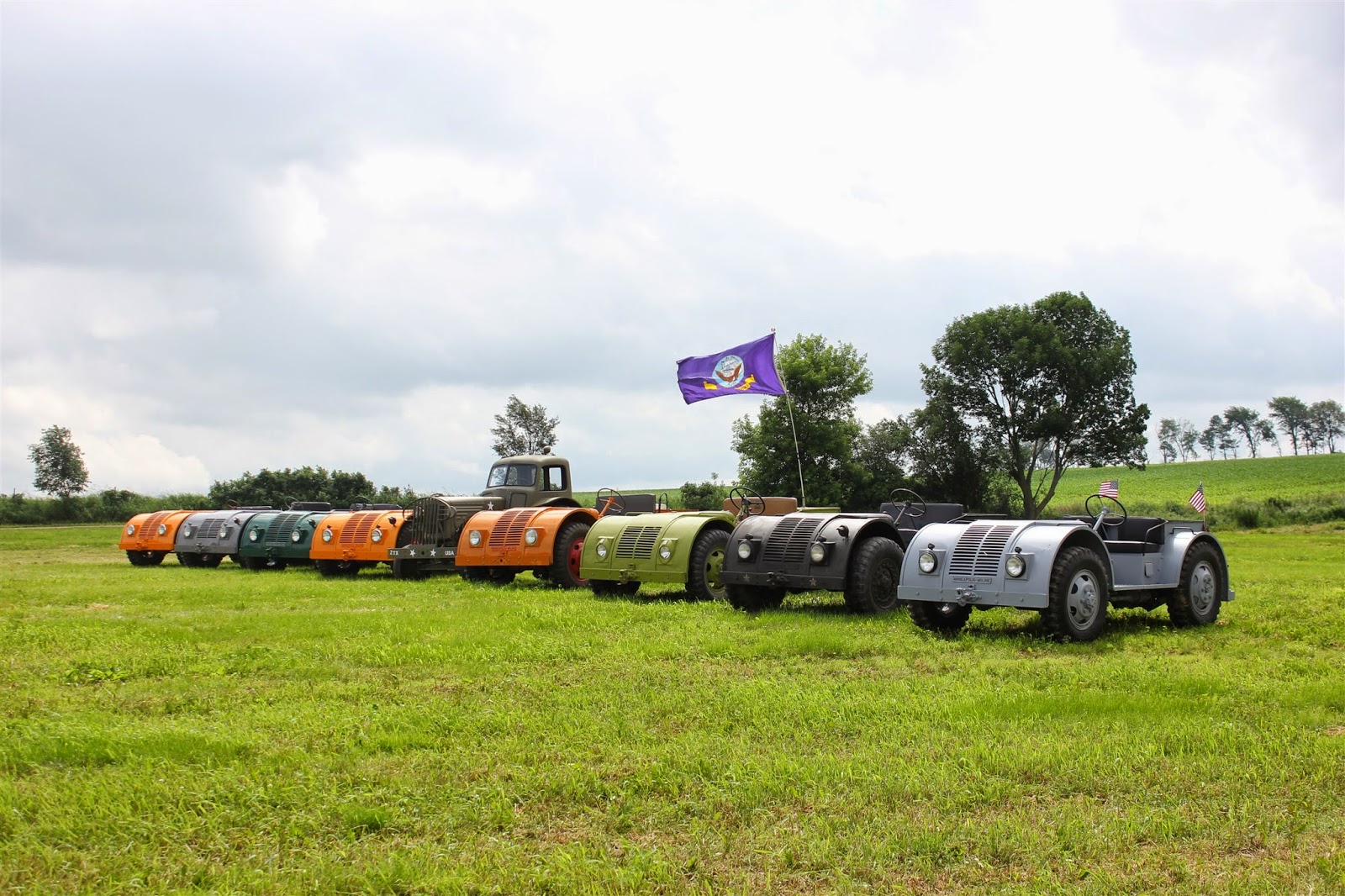
Cheryl turned out to be a great source of information.  She not only publishes "The Prairie Gold Rush" a quarterly magazine for Minneapolis-Moline enthusiasts, but owns a NTX  Jeep!   The NTX was designed as a military vehicle, not as a tractor.  Cheryl sent us this photo and included the following note -

"I have attached a picture of the NTX's we displayed at the Rice Lake WI Show in June of this year. It is the most NTX Jeeps we have ever gathered in one place. However, there are still at least 18 more out there we know of (in various degrees of restoration of course) that did not show up. There were 840 built (which we are sure of) and really don't know how many have survived. They are a really fun vehicle to own. My NTX is gray, the closest one in the picture with the American flags."


 Also included in this group shot is the NTX that made an appearance in the 1944 movie The_Fighting_Seabees.

Other MM folks were quick to point out that Willys had stolen the "jeep" name and had been sued by MM to stop them from using it.  Hmmm,  the Farm Jeep doesn't have the word Jeep stamped anywhere on the body.   Could it be they are correct? After this quick history lesson, it is clear that this was the first vehicle with the "jeep" name and it was not a Willys.  For more info on the NTX, check out this article- The Industrial Jeep - 1943 NTX

Just what is a tractor?

Following this informative encounter, Barry headed over to the RFD network's Classic Tractor show exhibit.  They were covering the show and selling DVDs and other tractor related items.  Barry didn't see any Farm Jeep information and inquired if they might have any jeep related items.  The short answer was "No, we do tractors, not jeeps."  The challenge was on, so Barry did his best to educate them.  He showed them copies of ads and tried to make his case that the jeep should be on the tractor show.  Time will tell.

Six degrees of separation?

Following the conversations with Cheryl and the RFD crew, Barry started looking for more NTX information  and  came across some interesting facts.  From the CJ3a info page -

"Willys involvement with farming and tractors started long before the Jeep. After WWI tractors started to replace the horse on the farm. At this time John N. Willys, with several partners, purchased the Moline Plow Co. and Willys-Overland produced the Universal Tractor. In the 1920's Mr. Willys sold out to his partners. For more information about the Moline Plow Company see the unofficial Minneapolis-Moline web-site."


Barry passed this information along to the MM folks, in hopes that they might feel more kindly toward the Farm Jeep.  He also came across a site with great Farm Jeep history.  Check out This-Old-Jeep.com.

We look forward to more shows and learning more about our version of the Jeep.